Our most aligned vantage point exists in our own inner space. But if you also see yourself in part through others’ eyes things can get complicated.
I think I’d rather be a Lady of the Lake or other mythical kind of thing, but what I know instead is poorly drawn explainers of spiritual mechanics. Enjoy…

Ever since I read some1 Immanual Kant on empiricism, I found myself sorting various types of life experiences into two categories: sensory and interior. It’s how I make sense of my life because things feels so rich in both realms, and I don’t want to sound insane.
Ah, All About The Outside
Sensory, or external experience, includes all things we can sense, measure, or easily name. It is the stuff we experience together as matter that can be acted on by ourselves and others.
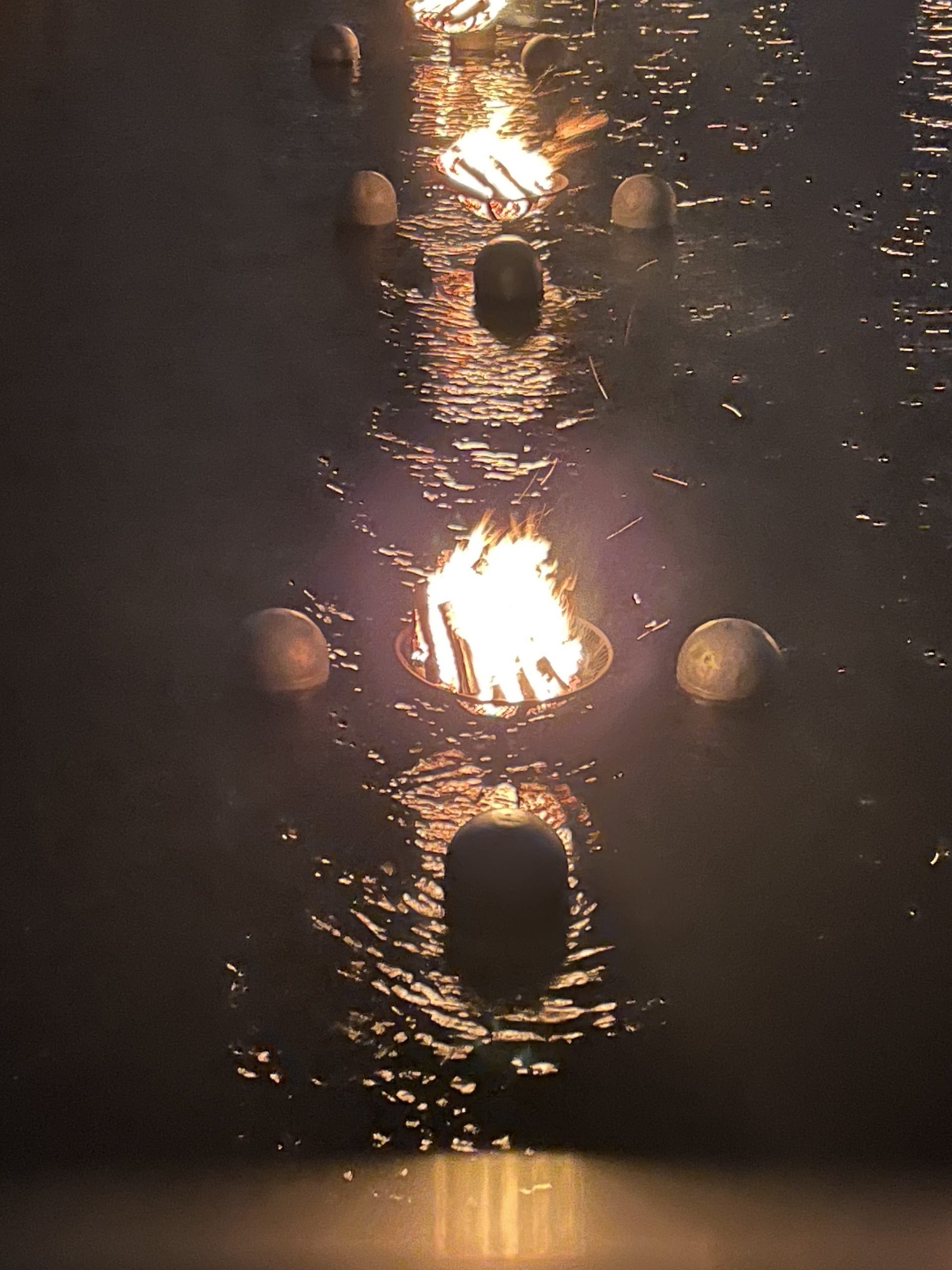
Fire is something we all understand: it burns, and we can measure it by temperature, and we can do things with it to affect other parts of the world like light a cigarette, burn down a house, or warm a village by bonfire.
Jerry Seinfeld says about discomfort in the sensory world, “pain is knowledge rushing in to fill a void with great speed,” like when you stub your toe because you didn’t see the bedpost. The pain in the sensory world is real – blood rushing to your foot, scrunching up your face, and wincing. This is the kind of sensory stuff no one likes. And fortunately it usually doesn’t persist.
The body + time self-correct nearly all sensory discomforts.
The sensory world is the only “real world” to some, certainly to materialists, maybe also to Buddhists. The sensory world is certainly the easiest one to speak about with others: it includes measurement, facts, and is non-dependent of anyone’s perception of it. Our shared sensory world includes nature, science, the ground and sky, and bedposts, and can be sometimes be navigated by clear verbal communication and demonstration.
The sensory world is where people get hungry and need food to live. It’s also the place where steel skyscrapers touch clouds, where calculators calculate, and where stars explode into super novas.
The sensory world is made of vibrating atoms, and includes the relational dynamics of matter interacting with other matter. Gravity is one such relationship: bodies of mass gravitate toward each other and actually bend space-time. The greater the mass, the more the action toward center.
For another practical example, when an adult jumps into a kiddie pool, half the water splashes out and the kids have only a lame ass puddle to splash in after that.2
Inside Job
Our ‘inside’ experiences can be rich with narratives and explanations, ideas and dreams, wishes and hopes, grudges and forgiveness, and often visions of what was, or should be3. Inner worlds are the spaces from which artists and musicians bring gifts to bear to the external word. It’s full of takeaways of books we’ve read, memories, and maybe even creative thoughts.
Much of the stuffs of our world has come about because some people brought inner fruits to bear in the outside world. Trains, Planes and Automobiles4, Mocha Lattes, and Half Decent Shoes, anyway.
Inner discomfort is different than sensory pain. Inner pain is having confusion about ideas about ideas. The Buddhists call this kind of pain suffering, and it can be dropped in a moment, even if your toe is still throbbing. Ideas like “this sh!t always happens to me,” or “is is broken?” or even a prolonged “ouch,” is the definition of inner suffering. AKA, clinging of mind.
Telling a story about your experience is also a way of holding the pain, but if it is a great story, telling it may also help someone else transmute theirs.
It’s hard to say. Literally, it is hard to say in which way your stories will be received.
Mental suffering shows up in self-esteem issues, confidence or lack thereof, patterning, mental illness, and dogma. And all beliefs are by definition, interior experiences. Because these interior experiences are made only of thought, patterns and energy, they can be shifted as fast as thought evaporates or the wind blows.
Leaving like a wispy cloud on a sunny day.
Holes and Holds of Ignorance
Like everyone else with blind spots, I’ve experienced my share suffering and am still trying to unwind these two distinct experiences from one another so I can write. Mommess here is a mixture of each: Inner and Sensory; Musings and Pop Culture; Dreams and Science.
And the more I try to create a clear line between inner and outer, the more I realize these realms are inextricably linked, with the nexus of connection being my unique vantage point of the world, tainted by my personal history, and residing in my body.
And I am no different than any one else in this world. IE, we all are a nexus. No big deal.
Like all of us, my inner life directly affects how I experience my outer life, and my outer life conversely affects my future hopes and dreams too. When I feel unseen or erased (ever experience this at work, just because you refuse to stick your name all over something?), I have tended to feel hurt and then hide out emotionally. That hiding out can then cause me to be overlooked some more, or misunderstood. Then a wacky spiral could begin.
Conversely, when I feel understood or appreciated, I tend to rise higher. And I think we all do this. We all want to be seen for our inner and outer selves accurately, at once. That’s center alignment.
But truth is, center alignment can only be experienced from the inside (see diagram above), not mentally derived from others’ supposed views of us. That’s just a mess.
And because we all are flawed humans with holes in perception and holds on our beliefs, we may never feel seen correctly through anyone else’s eyes. And that’s okay. As long as we see ourselves, and decide to be kind.
the magic of being seen
This nexus of inner and outer is where magic of synchronicity, growth, and miracles happen. And that’s because when you have a rich inner life and engaged outer life, YOU become the nexus of your experience. No one can really can’t be anything but their own nexus, so it’s no big deal. Veing a nexus is simply being courageous enough to let some of the inner you also go out there too: like an artist, or poet, or musician, or even a great actor does.
What you care about, manifested, by your own hand in your own time, with the help of others who believe in you.
words to the wise
The only challenge here is if YOU feel non-specific, a pitfall that happens to some women, trained on empathy and taught to self-evaluate through the gaze of others. If a person is naturally attuned to others via emotional or psychic gifts, they may also have built their self-worth from external validation of their external attunement. The diagram at top shows the mechanics of seeing yourself through others’ gaze. Not only is it a mess, it cannot, by its nature, be accurate either.
No one outside can ever see the entirety of you. So if you look to others for a sense of who you are, you may feel fractured, messy, or incomplete, or like a wicked pile of spaghetti masquerading as a whole person.
This is because the mechanics of seeing yourself through others’ eyes means your vantage point is necessarily outside your body looking in. This is not the same as being centered, aligned or attuned, and recognizing other people as the same. In the diagram at top, you can see the vertical lines of identity are different depending on who is doing the looking.
These vertical lines are like a projection, what someone may see in you from their view point. Like a film projector on a movie screen, it’s fun to watch, but may be a fiction to your actual lived experience.
This mechanical view of consciousness makes me rethink how we come to know things, especially if we experience ourselves as a conglomerate of ideas, learning, friends, families and influences, or see ourselves through the eyes of others by default.
Where are we standing while we evaluate who we are and what we want to envision next?
The evaluation necessarily comes from “outside” ourselves. “How do I appear to them?” “What would I call myself if I were them?” “What do I call myself in these (likely commercially branded) shoes?”
In my interior life, I occasionally have found the world unnerving, like a place of predatory characters seeking to steal my energy and leave me for dead. But in the sensory world, I may just take a paycheck and say, “okay, that’s what I agreed to,” and (if I’m lucky) carry on to make another exchange on another day.
So sorting the inner from the outer is kind of important to maintain credibility and integrity with others, but what’s really important, I believe, is maintaining center with oneself, even if no one understands you.
FOOTNOTES & SUB-SUBTEXT 😉
- I could not get all the way through the book, I must say, but here it is . ↩︎
- Who else had a shallow kiddie pool as a kid? I’ll never forget the story of the time a tired neighborhood dad decided to stick his feet in the communal kiddie pool. He had athlete’s foot and every kid in the row house wound up with pink eye right after. So funny now, but the mom’s were all like, “really dude?” ↩︎
- If you are well versed in physics or quantum mechanics, you may say instead, these other things “are” just in another state, and if entangled, perhaps even changing in concert with one another. ↩︎
- Good movie 1987. ↩︎